How I Think About System Architecture Before Writing Code
Ahmad Waqar
Full-Stack Developer & Technical Writer. Passionate about building great software and sharing knowledge.
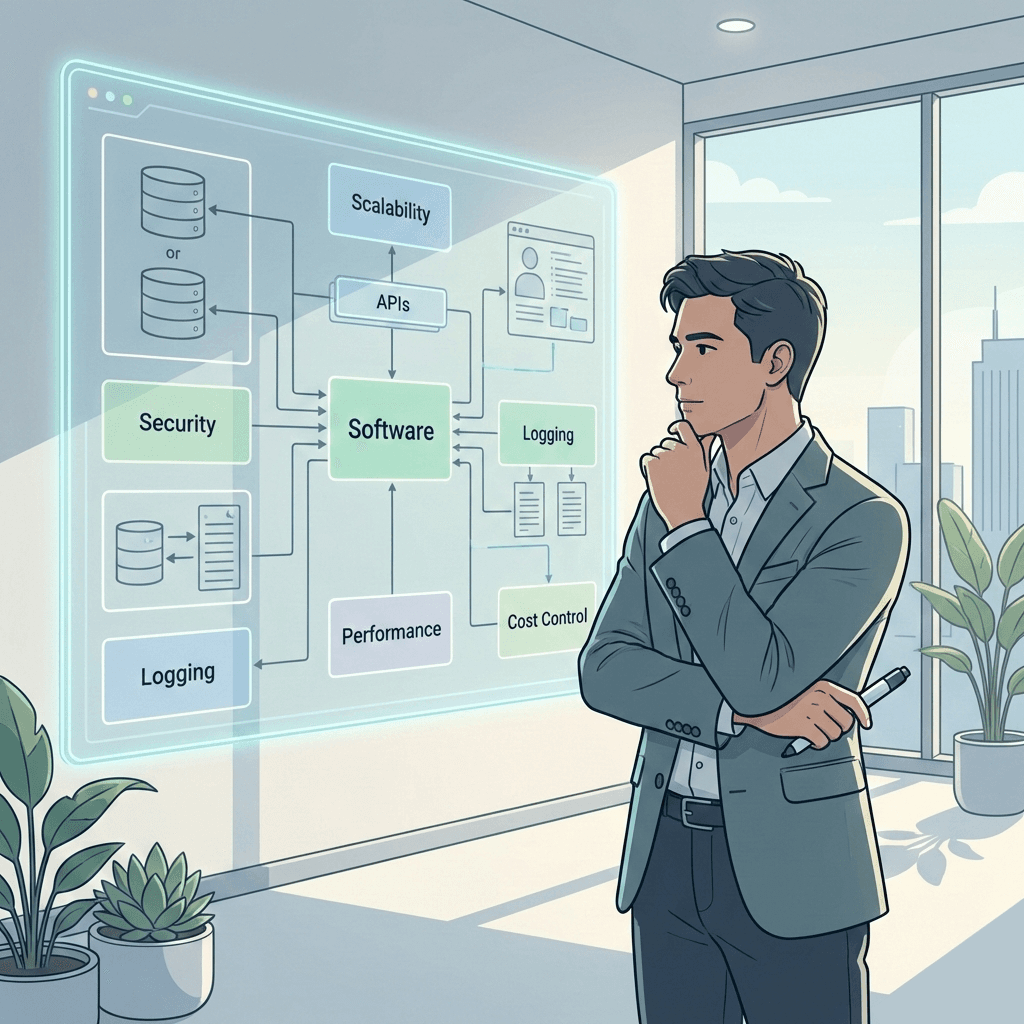
How I Think About System Architecture Before Writing Code
Before I write a single line of code, I think about architecture.
Not UI.
Not features.
Not libraries.
Architecture.
Because once implementation begins, architectural decisions become harder and more expensive to change.
Here is the framework I use before building any production system.
1. Stack & Reach
The first question is not “What’s trending?”
It’s:
What stack maximizes performance and discoverability?
Will this choice limit growth later?
Can this system evolve without rewrites?
The goal is not speed today.
The goal is flexibility tomorrow.
2. Performance & Scalability
Every system faces load eventually.
Before building, I ask:
Where are potential bottlenecks?
Can the system scale horizontally?
How does it behave under traffic spikes?
What components are stateful vs stateless?
Scalability is easier to design early than retrofit later.
3. Logging & Observability
If something fails, how quickly will I know?
I think about:
Structured logging
Error tracking
Monitoring
Clear traceability
A system without observability is a system you cannot trust.
4. Security & Trust
Security is not an add-on.
It’s architectural.
Questions I consider:
How is authentication handled?
How is authorization enforced?
Where is sensitive data stored?
What is the attack surface?
Trust is earned through design decisions, not UI polish.
5. Failure Control
Systems fail. That is inevitable.
The real question is:
Do failures cascade?
Is there graceful degradation?
Are errors contained?
Is there retry logic or fallback behavior?
Resilience is intentional.
6. Budget & External Integrations
Modern systems rely on external services.
Before integrating, I think about:
Cost ceilings
Rate limits
Fallback plans
What happens if an integration fails
Architecture includes financial discipline.
The Core Principle
Architecture is not about choosing tools.
It is about reducing risk.
Code is implementation.
Architecture is responsibility.
The better the architecture, the fewer surprises later.
And surprises in production are expensive.
Comments (0)
No comments yet. Be the first to share your thoughts!