FastAPI: Backend Framework or Service Framework?
Ahmad Waqar
Full-Stack Developer & Technical Writer. Passionate about building great software and sharing knowledge.
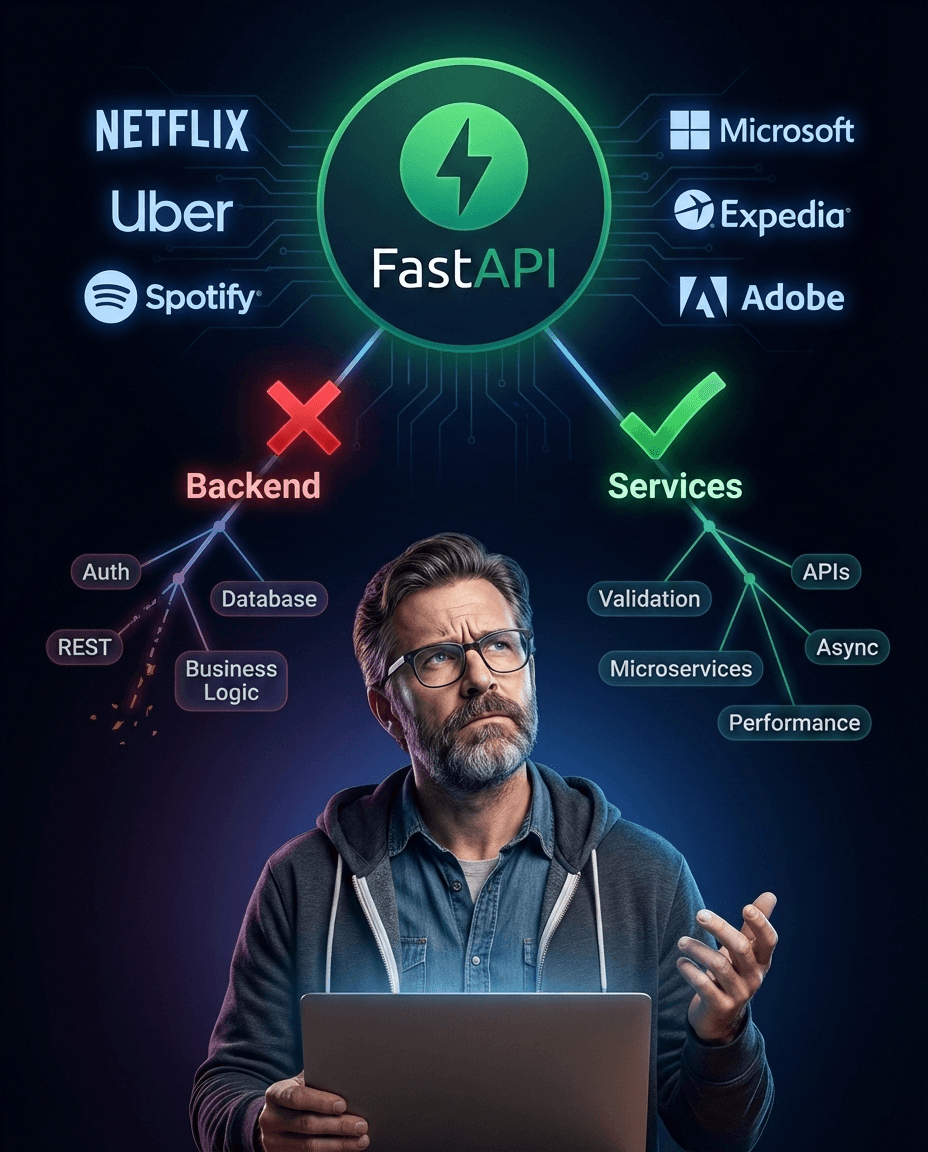
FastAPI: Backend Framework or Service Framework?
FastAPI is one of the most popular Python frameworks today.
It’s fast, elegant, and a joy to work with.
But a common question keeps coming up:
Is FastAPI a backend framework, or is it better suited as a service framework?
The answer matters — especially when designing real systems.
How Web Frameworks Are Commonly Categorized
In practice, web frameworks usually fall into a few categories:
Frontend frameworks – focus on UI and user interaction
Backend frameworks – handle auth, databases, business logic, and APIs
REST frameworks – focus on API design and data exchange
Service frameworks – optimized for isolated services and microservices
Some frameworks clearly belong to one category. Others blur the lines.
FastAPI sits in an interesting position.
What FastAPI Is Optimized For
FastAPI’s structure is designed around APIs first.
It excels at:
Handling HTTP requests and responses
Data validation using Pydantic
Clear, explicit API contracts
Async and high-performance workloads
Automatic OpenAPI and documentation generation
These strengths make FastAPI a natural fit for:
Microservices
Internal services
AI and ML model serving
Event-driven systems
API gateways
This is where FastAPI truly shines.
Why FastAPI Is Widely Used as a Service Framework
FastAPI is lightweight and unopinionated.
That’s a strength — but also a clue.
It does not impose:
A database structure
An authentication system
A permission model
An admin interface
A long-term application architecture
Instead, it gives you building blocks and lets you decide.
This flexibility is perfect for services, where isolation, clarity, and performance matter more than conventions.
Where FastAPI Falls Short as a Full Backend
FastAPI can be used to build a full REST backend — but it doesn’t do it for you.
Things you must assemble yourself:
Authentication and authorization
ORM and migrations
Permissions and roles
Admin tooling
Complex relational business logic
As systems grow, this can lead to:
Inconsistent patterns
Higher maintenance cost
Architecture drift
Frameworks like Django are opinionated by design, which makes them better suited for long-lived, data-heavy backends.
FastAPI vs Django: Different Goals
This isn’t a competition.
Django is a full-stack backend framework built for complete systems.
FastAPI is a service-first framework built for APIs and microservices.
Many mature architectures use both:
Django for the core backend
FastAPI for isolated services and performance-critical APIs
Used together, they complement each other extremely well.
How to Choose the Right Tool
Use FastAPI when you need:
Fast, scalable services
Clear API boundaries
Async performance
Independent deployment
Use a full backend framework when you need:
Authentication-heavy systems
Complex data relationships
Admin interfaces
Long-term maintainability
Good architecture isn’t about picking the most popular tool.
It’s about picking the right one.
Final Thoughts
FastAPI is not a replacement for full backend frameworks — and it doesn’t need to be.
Its strength lies in being an exceptional service framework.
Understanding this distinction leads to better system design, cleaner architectures, and fewer painful rewrites down the line.
Choose tools based on what they do best — and your systems will scale with you.
Comments (0)
No comments yet. Be the first to share your thoughts!