Agentic AI in Full-Stack Development: How Software Went from Months to Days
Ahmad Waqar
Full-Stack Developer & Technical Writer. Passionate about building great software and sharing knowledge.
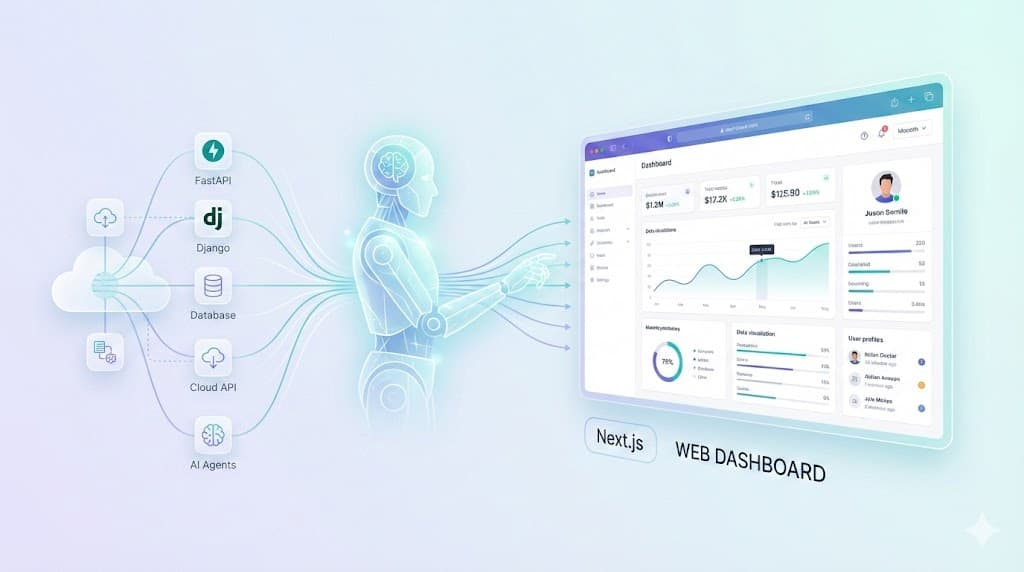
Building Full-Stack Products with Agentic AI: From Months to Days
Building a production-ready full-stack application used to be a slow, heavyweight process.
Weeks of boilerplate.
Long handoffs between frontend and backend.
Painful refactors once requirements inevitably changed.
That workflow is becoming obsolete.
Today, with agentic AI, building software is less about grinding through implementation and more about directing intelligent systems that can execute, review, and iterate alongside you.
The Old Model: Slow, Rigid, Expensive
Not long ago, shipping a serious application meant:
Weeks setting up backend infrastructure
Manually defining schemas, serializers, and validation
Writing repetitive tests and documentation
Waiting for frontend and backend to align
Discovering product flaws late in the process
This made early-stage experimentation risky.
By the time something shipped, changing direction was costly.
The New Model: Agentic AI as a Development Partner
Agentic AI changes the role of the developer.
Instead of asking AI to just write code, we treat it like a junior engineer that can:
Take clear instructions
Execute multi-step tasks
Maintain context across the codebase
Review and improve its own output
Iterate continuously without fatigue
In my current workflow, I use tools like Copilot and Cursor alongside FastAPI, Django, and Next.js to build full-stack systems end to end.
What This Looks Like in Practice
With agentic AI in the loop, I can:
Scaffold backend APIs in hours instead of days
Generate typed schemas, serializers, and models automatically
Create tests and documentation as part of the same flow
Build clean Next.js frontends in parallel with backend work
Refactor, debug, and optimize continuously as requirements evolve
Ship usable versions while the product is still taking shape
The key advantage isn’t speed alone — it’s parallelization and feedback.
Frontend and backend no longer block each other.
Iteration happens continuously instead of in large, risky chunks.
The Real Shift: From Code Generation to Execution
The biggest misconception about AI in development is that “AI writes code.”
That’s not the shift.
The real shift is that AI executes development work under human direction.
Think of it this way:
You define intent and constraints
The AI handles implementation details
You review, correct, and steer
The system improves as context grows
This creates a tight feedback loop that feels closer to pair programming than automation.
Why This Matters for Startups and Founders
For startups, this changes everything.
Instead of:
> “Let’s plan for 3–4 months before launch.”
You get:
> “Let’s ship a real product in days and iterate with users.”
This doesn’t mean cutting corners.
It means:
Faster feedback
Better product decisions
Lower cost of mistakes
Less wasted engineering effort
Speed here isn’t about recklessness — it’s about learning (and correcting) earlier.
The Growing Gap
Teams using agentic AI are already operating differently.
They:
Ship earlier
Iterate more often
Adapt faster to user feedback
Meanwhile, teams ignoring this shift are still stuck optimizing workflows that no longer define the frontier.
That gap is growing — and it’s not about talent.
It’s about tooling, mindset, and execution.
Final Thoughts
Agentic AI doesn’t replace developers.
It amplifies them.
The future of full-stack development belongs to people who know how to:
Think clearly
Give precise instructions
Evaluate outputs critically
And collaborate effectively with intelligent systems
This is how modern products are being built now.
If you’re curious how this works in real projects — or want to collaborate — I’m always happy to share and explore ideas together.
Built in public. Learning fast. Shipping faster.
Comments (1)

This looks great!!!