How I Use AI to Build Production-Ready Software Systems
Ahmad Waqar
Full-Stack Developer & Technical Writer. Passionate about building great software and sharing knowledge.
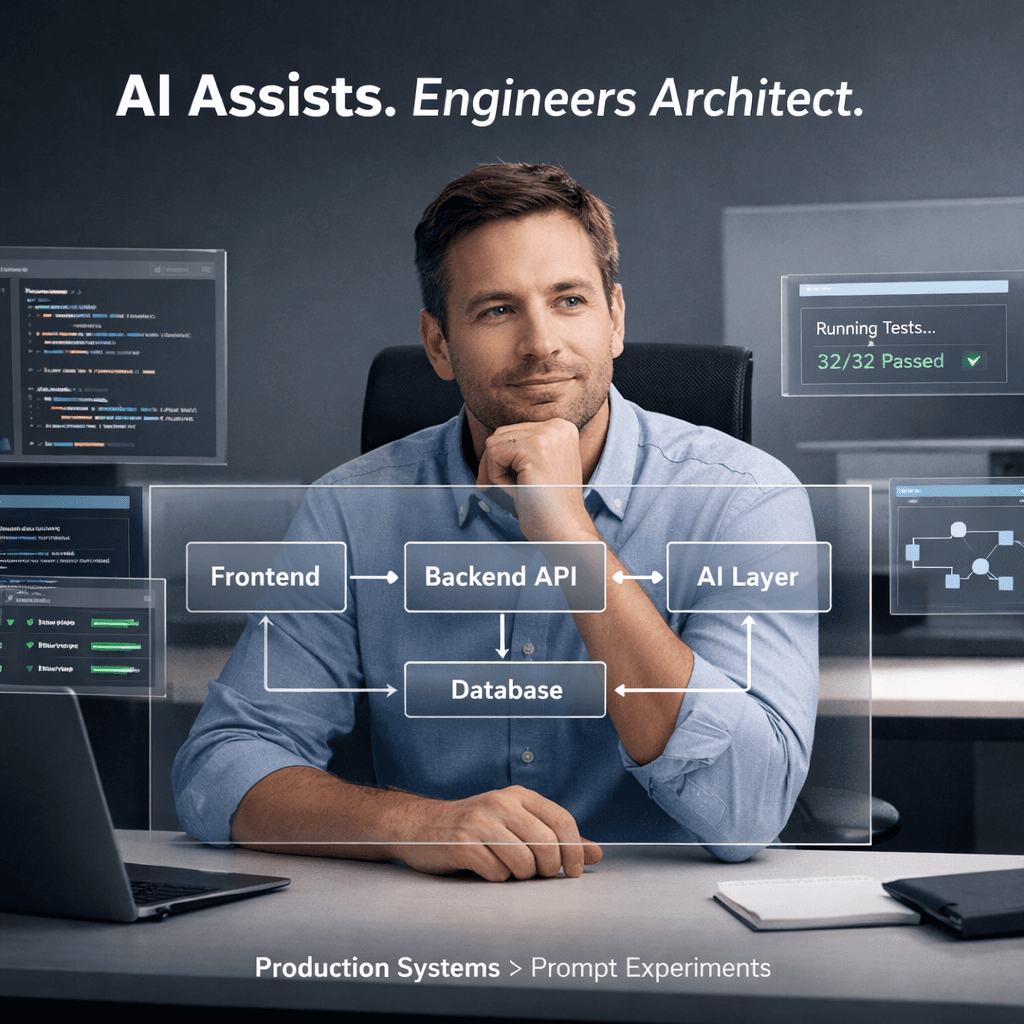
How I Use AI to Build Production-Ready Software Systems
There’s a growing belief that AI “builds” modern software.
It doesn’t.
AI accelerates development. Engineers build systems.
Here’s how I actually use AI when working on production-level applications.
1. Define Intent Before Writing Code
Before touching the editor, I clarify:
Who is this system for?
What problem does it solve?
What data is critical?
What absolutely cannot fail?
If those answers are unclear, no amount of AI will fix the architecture later.
AI is powerful, but responsibility still belongs to the engineer.
2. Pressure-Test Architecture With AI
Once the intent is clear, I use AI as a technical sparring partner.
I ask:
Where could this design break at scale?
What are possible bottlenecks?
Is this over-engineered?
What edge cases am I missing?
This stage is about thinking — not coding.
AI helps explore alternatives quickly, but final decisions are mine.
3. Break the System Into Controlled Parts
I never ask AI to generate an entire system at once.
Instead, I divide the architecture into layers:
Frontend
API layer
Data layer
Background tasks
Automation logic
Each part is handled independently.
This prevents complexity from spreading across the entire codebase.
4. Generate, Then Refactor
AI drafts code quickly.
Then I:
simplify logic
remove unnecessary abstractions
standardize naming
improve structure
add proper error handling
I review AI-generated code the same way I would review junior developer code.
Speed is useful.
Discipline is essential.
5. Test Intentionally
Sometimes I write tests myself.
Sometimes I ask AI to generate edge-case tests.
Either way, validation is deliberate.
Production systems require predictable behavior, not clever prompts.
6. Optimize After Stability
First, make it correct.
Then, make it clean.
Then, make it fast.
AI helps in all three stages — but engineering judgment determines what ships.
Final Thought
AI doesn’t replace engineers.
It amplifies engineers who already understand systems.
Used carelessly, it increases technical debt.
Used intentionally, it increases clarity and speed.
The difference isn’t the model.
It’s the discipline.
Comments (0)
No comments yet. Be the first to share your thoughts!