My Agentic Coding Workflow: Building Production Systems with AI
Ahmad Waqar
Full-Stack Developer & Technical Writer. Passionate about building great software and sharing knowledge.
My Agentic Coding Workflow: Building Production Systems with AI
AI-assisted development only works well when the workflow is structured.
Without structure, you get inconsistent code, broken builds, and hidden technical debt.
Over time, I’ve developed a repeatable “agentic coding” workflow that allows me to move fast while maintaining architectural control.
Here’s how it works.
1. Lock the Baseline First
Before involving AI heavily, I initialize a clean project foundation.
For example, in a Next.js project, I:
Install the latest stable version
Add required dependencies immediately (e.g., Prisma, auth libraries)
Lock core versions
Explicitly prevent dependency downgrades
This avoids confusion between framework versions and prevents AI from suggesting outdated patterns.
A clean baseline reduces 80% of early friction.
2. Use a Strong Model for Architecture, Not Just Code
I don’t start by generating features.
I start by designing the system.
Using a high-capability model, I clarify:
What the system does
Database structure
API boundaries
UI layout
Core constraints
Definition of “production-ready”
Architecture first. Implementation second.
3. Create a Persistent Context Layer
AI performs better when given structured memory.
I create internal project files such as:
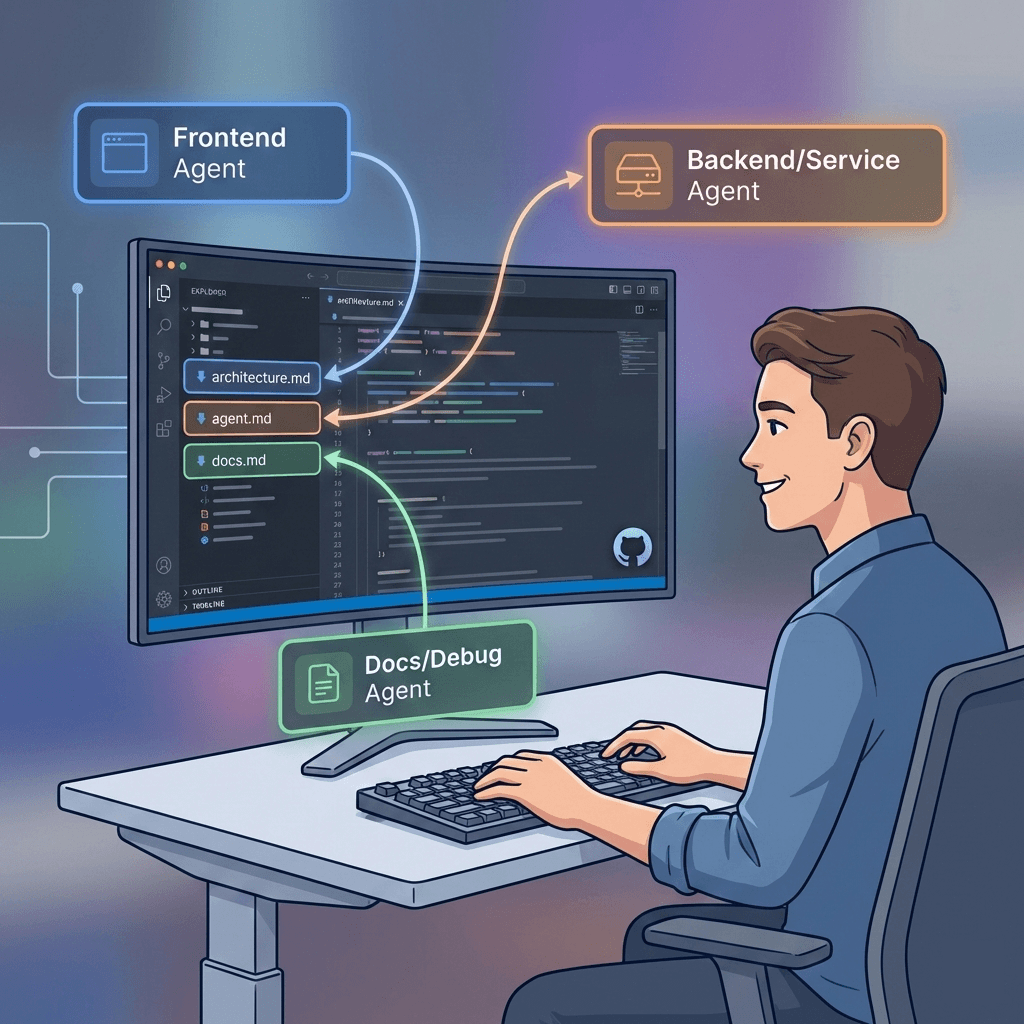
architecture.md
agent.md
docs.md
These act as a shared reference for all subsequent agents and models.
They document:
System structure
Route definitions
API endpoints
Data models
File locations
Integration points
This dramatically improves debugging and iteration speed.
4. Split Work Across Focused Agents
Instead of one massive prompt, I divide execution into lanes:
Frontend agent
Backend/service agent
Documentation/debugging agent
Each agent operates within defined scope and updates documentation as changes are made.
This prevents architectural drift and keeps the system coherent.
5. Build, Validate, and Iterate
As agents generate and modify code:
Build checks are run
Errors are resolved incrementally
Documentation is updated continuously
Once the system stabilizes, I perform manual review and testing.
I treat AI output like junior code:
Refactor aggressively
Simplify complexity
Enforce naming consistency
Strengthen error handling
Only after human validation does the system move toward production.
6. Iterate Until Production-Ready
A project becomes production-ready when:
Builds succeed consistently
Architecture is clean
Documentation is clear
Core flows are tested
No hidden inconsistencies remain
AI accelerates execution.
Discipline ensures quality.
Why This Workflow Works
The key is not the model.
It’s the structure.
Agentic coding works when:
Context is explicit
Roles are separated
Documentation is living
Review remains human
Responsibility is clear
AI does not replace engineering thinking.
It amplifies it.
When orchestrated correctly, it transforms development from linear implementation into parallel execution under control.
That is the real advantage.
Comments (0)
No comments yet. Be the first to share your thoughts!