What Claude Got Wrong Building My Blog (And What It Taught Me About AI Development)
Ahmad Waqar
Full-Stack Developer & Technical Writer. Passionate about building great software and sharing knowledge.
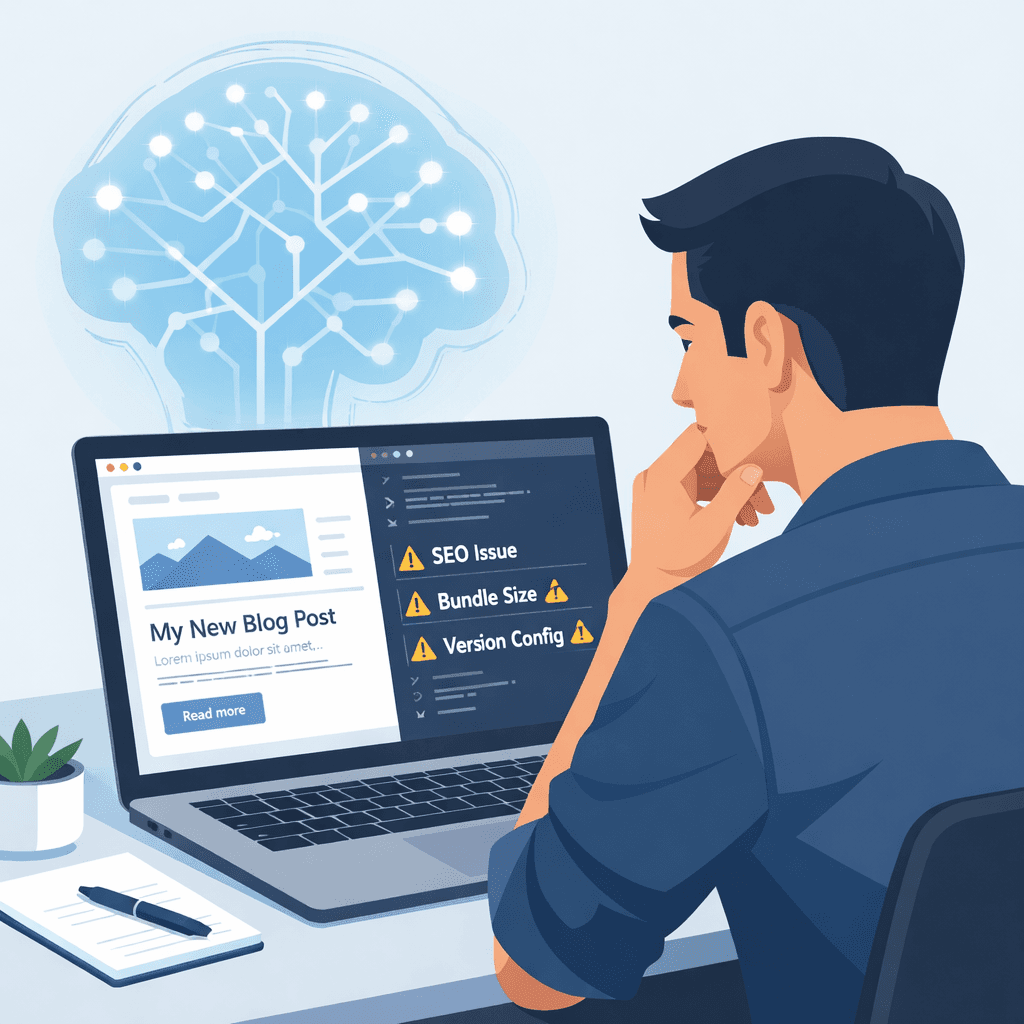
What Claude Got Wrong Building My Blog
(And What It Taught Me About AI Development)
I recently built a blogging platform using Claude as my primary AI assistant.
Overall, the experience was impressive.
The system was structured, features were implemented cleanly, and iteration speed was high.
But it wasn’t flawless.
And the flaws were instructive.
1. Ecosystem Awareness Gaps
Modern JavaScript ecosystems evolve quickly.
During development, I noticed:
Confusion around the Next.js middleware → proxy shift
Patterns that didn’t fully align with Prisma v7
Suggestions inconsistent with NextAuth v5
None of these issues were catastrophic.
But they highlight something important:
AI models do not automatically track the latest framework changes with precision.
When working in fast-moving stacks, version awareness is still a human responsibility.
2. SEO Was Not a Priority
This one surprised me.
The project was a blogging platform.
Yet:
Static params were not properly generated
Metadata handling was minimal
No deliberate SEO-first structure was implemented
The UI was polished.
Routing worked.
Features were clean.
But discoverability — arguably the most important aspect of a blog — was not prioritized.
AI optimized visible complexity (interface and structure) over invisible impact (SEO and indexing strategy).
3. JavaScript Bundle Size
The generated build produced a larger-than-ideal JavaScript bundle.
Interestingly, performance still felt acceptable.
This exposed a subtle point:
AI can generate systems that feel fast without being structurally optimal.
Perception is not the same as performance discipline.
Optimization still requires intentional engineering decisions.
4. Where Claude Performed Extremely Well
It’s equally important to acknowledge what worked.
Claude handled:
Feature extensions cleanly
Refactors without breaking unrelated logic
Structural consistency across updates
When asked to modify specific components, it rarely introduced cascading failures.
That level of localized reasoning is powerful.
What This Taught Me
AI is strong at:
Localized implementation
Feature iteration
Structural continuity
AI is weaker at:
Ecosystem nuance
Strategic prioritization
Long-term architectural trade-offs
AI accelerates execution.
But it does not inherently understand what matters most for your product.
That remains the engineer’s role.
Final Thoughts
AI-assisted development is real, powerful, and transformative.
But it is not autonomous engineering.
It is amplified execution under human direction.
The difference between impressive demos and production-ready systems is still:
Version awareness
Strategic thinking
Performance discipline
Clear architectural intent
Claude didn’t fail.
It revealed where human judgment is still essential.
And that’s the real lesson.
Comments (0)
No comments yet. Be the first to share your thoughts!